Carpenter ant damage differs fundamentally from termite destruction because carpenter ants do not digest cellulose; they hollow out sound and moisture-compromised lumber to construct clean nesting galleries. In Storm…
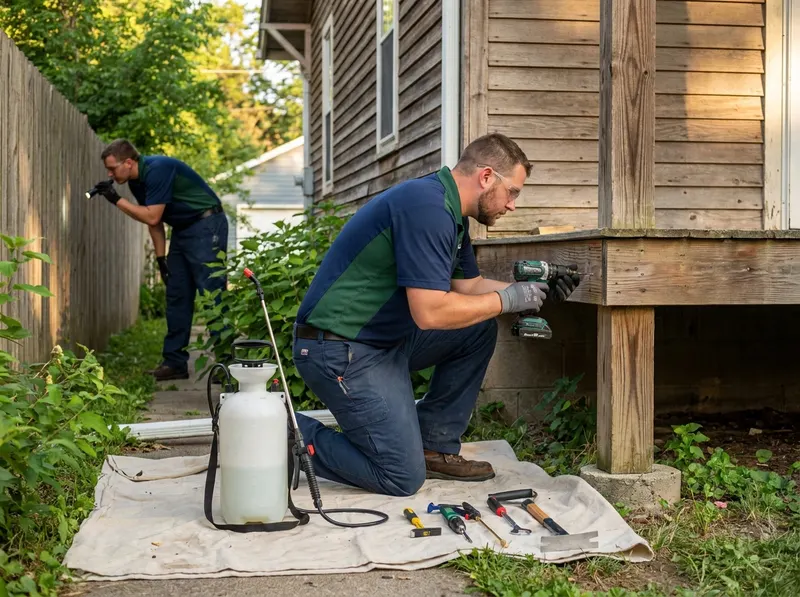
Carpenter ant damage differs fundamentally from termite destruction because carpenter ants do not digest cellulose; they hollow out sound and moisture-compromised lumber to construct clean nesting galleries. In Storm Lake, structural vulnerabilities cluster around roof valleys, sill plates, and window casings exposed to severe humidity swings off the lake. Properties throughout the Seneca Street Historic District and older two-story builds near College Hill frequently exhibit satellite nesting inside structural joists beneath aging bathrooms and porch transitions. Modern stick-built constructions in Emerald Park and Sunrise Pointe Area often experience perimeter intrusions driven by ground moisture and seasonal landscape transitions near Harkers Field. Targeted eradication injects non-repellent transfer agents directly into active wall voids, preventing the colony from simply relocating to an adjacent wall bay.
Decision guidance depends on the age and moisture profile of the building. Homeowners discovering isolated black ants on kitchen counters often assume topical aerosol sprays provide sufficient control, but surface repellents fracture colonies, prompting queens to disperse satellite nests across additional structural zones. If interior sawdust piles containing insect parts, known as frass, accumulate beneath baseboards or window aprons, void injection and parent colony tracking are required. Standard perimeter spraying treats foraging trails, whereas structural eradication penetrates the enclosed wall framing where reproduction occurs. The operational trade-off involves access: systemic void treatment requires small, precise 1/8-inch drill access holes into drywall or exterior sheathing to aerosolize active galleries, trading temporary cosmetic patching for complete biological termination.
Eradication protocols follow a strict three-phase procedure. First, acoustic and moisture diagnostics map humidity thresholds above 18% along sills, joist pockets, and plumbing walls. Second, non-repellent micro-encapsulated formulations are injected directly into active nesting cavities, allowing foraging ants to carry active ingredients back to the queen via grooming behaviors. Third, exterior perimeter barriers extend 3 feet up the foundation wall and 5 feet outward across soil and hardscapes, cutting off transit between tree-based parent colonies and the home. This targeted protocol eliminates ongoing contracts, providing standalone remediation backed by physical structural recommendations to prevent re-infestation.
Every job gets a firm, written price after a free on-site visit.
Tell us about your carpenter ant structural eradication job in Storm Lake and we'll send a clear, written quote, usually the same day.
 Corviro Pest Management