Subterranean termite treatment requires a decisive, barrier-first remediation strategy because Eastern subterranean termites (Reticulitermes flavipes) nest beneath the frost line in Buena Vista County soil. Moisture…
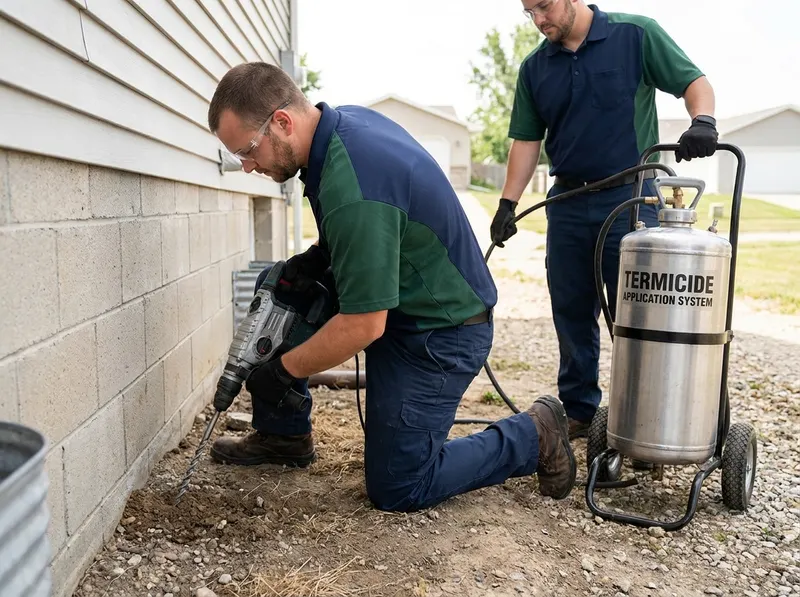
Subterranean termite treatment requires a decisive, barrier-first remediation strategy because Eastern subterranean termites (Reticulitermes flavipes) nest beneath the frost line in Buena Vista County soil. Moisture retention around lakefront properties in Lakeside and the Chautauqua Park Area accelerates termite foraging toward residential sill plates. Remediation relies on non-repellent liquid termiticides injected into a continuous trench along the exterior perimeter, or subterranean bait stations spaced every 10 to 12 feet around the structure. The non-repellent liquid binds to soil particles, remaining undetectable to worker termites, who pass through the treated zone and transfer the active ingredient throughout the subterranean colony through mutual grooming (trophallaxis). Termite control differs fundamentally from general pest spraying: superficial sprays fail to reach subterranean nests and leave internal wooden structural members vulnerable to ongoing hollow tunneling.
Older architectural stock in the Seneca Street Historic District and College Hill often features stone, brick, or uncapped hollow-block foundations that provide subterranean termites hidden vertical travel lanes. When mud tubes extend upward across masonry, remediation involves precise drilling through concrete slabs, porches, or basement floors at 12-inch intervals to establish an unbroken chemical zone underneath flat work. For slab-on-grade homes near Emerald Park or North Central Storm Lake, exterior soil rods deliver termiticides 4 to 6 inches deep adjacent to stem walls. Once liquid termiticide or insect growth regulator bait arrays are installed, worker populations collapse within 60 to 90 days. Non-repellent products bond tightly to native Northwest Iowa silty clay loam, minimizing horizontal leaching away from target foundation footings.
Remediation protocols exclude multi-year recurring service contracts in favor of defined, structural-grade applications backed by physical perimeter monitoring. The application formulations dry within 2 to 4 hours and lock into the soil matrix, eliminating airborne exposure risks for children and domestic animals once cured. In high-water-table zones near Sunrise Pointe Area and Frank Starr Park Area, baiting arrays offer an alternative remediation path when proximity to storm run-off precludes trenching. Every treatment plan concludes with an objective mapping of termite entry points, identified moisture zones from grade-level gutter discharges, and mechanical clearances between structural framing and exterior soil.
Every job gets a firm, written price after a free on-site visit.
Tell us about your subterranean termite treatment & remediation job in Storm Lake and we'll send a clear, written quote, usually the same day.
 Corviro Pest Management